Mapping User Navigation Paths Through Casino Interfaces During Peak Evening Hours
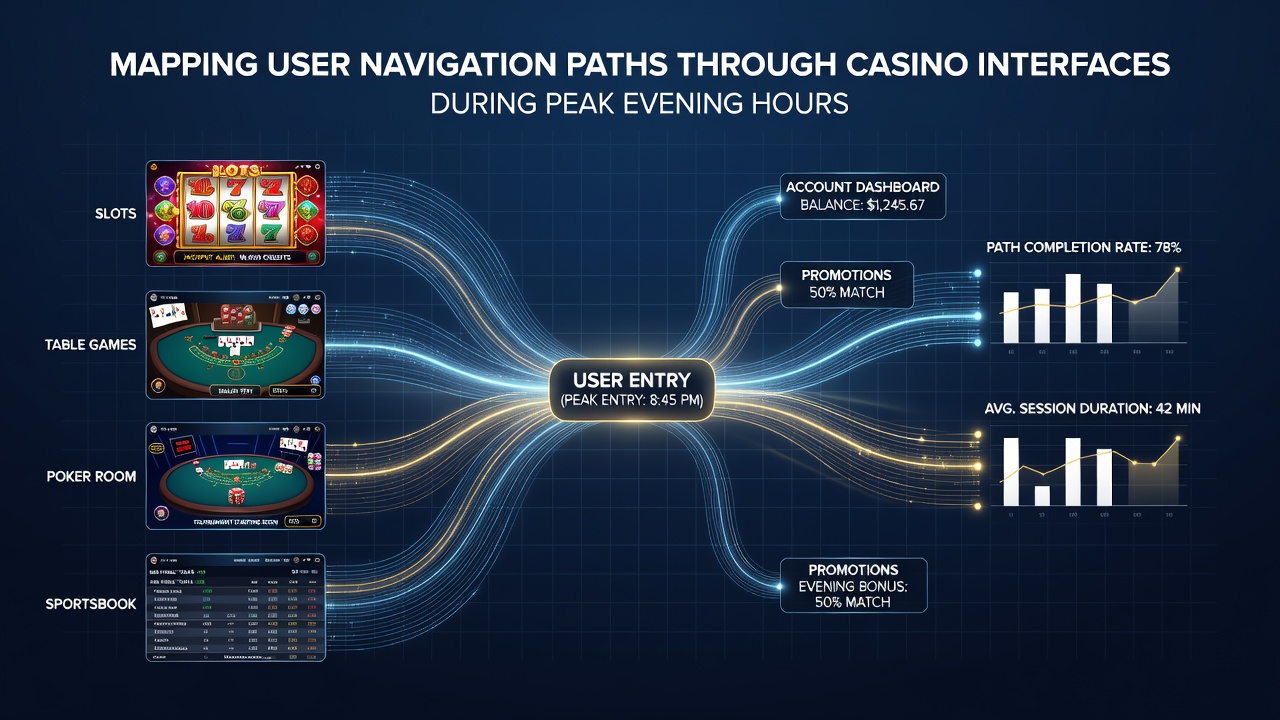 Analysts track user movement through casino platforms by collecting anonymized session data that reveals sequences of clicks, scrolls, and transitions between screens, and this process becomes especially detailed when focused on the hours between 7pm and midnight when traffic volumes rise across most regulated markets. Studies from research institutions show that navigation paths during these periods often follow repeatable structures, with users entering through lobby pages before branching toward specific game categories or promotional sections, while data aggregation tools convert raw logs into flow diagrams that highlight frequent routes and dropout points. Observers note that interface elements such as quick-access menus, search bars, and notification banners receive the highest interaction rates in the early evening window, and mapping these interactions requires combining clickstream analysis with session duration metrics to identify where users linger or accelerate their progress. In July 2026 several platforms reported updated tracking protocols that incorporated timestamped event data to distinguish between deliberate selections and accidental taps, producing clearer pictures of how evening users navigate from deposit screens to live table sections or slot lobbies.
Data Sources and Collection Techniques
Platform operators gather navigation data through embedded analytics scripts that record every screen transition without storing personally identifiable information, and regulatory bodies in regions including Nevada and Australia require periodic summaries of these patterns to verify compliance with responsible gaming standards. The American Gaming Association has published aggregated industry reports that describe how heat-mapping software overlays user paths onto interface layouts, revealing clusters around bonus claim buttons and game filter options during peak hours.
Researchers apply sequence mining algorithms to identify common chains such as home-to-slots-to-checkout, while excluding outliers that represent testing or bot activity, and this filtering step ensures the resulting maps reflect genuine player behavior across thousands of sessions collected over multiple weeks.
Evening Peak Patterns and Interface Flow
During peak evening hours navigation tends to concentrate around promotional carousels and personalized recommendation rows, after which users move toward game launch screens at higher rates than during daytime periods, according to session logs compiled by platform analytics teams. Figures from cross-platform studies indicate that average path length shortens in the 8pm to 10pm window as users who have already completed account verification proceed directly to favored titles, bypassing several intermediate steps that appear more often in morning traffic.

Those who monitor real-time dashboards observe that back-button usage spikes after users reach game detail pages, suggesting a comparison phase that occurs more frequently once evening engagement builds, and mapping tools capture these reversals as distinct loops within overall journey visualizations. Data from European operators shows that mobile interfaces record denser path networks than desktop versions during the same hours because swipe gestures and tab switches generate additional transition events that desktop mouse clicks do not produce.
Regional and Platform Variations
Navigation maps differ by jurisdiction because local regulations influence the placement and prominence of responsible gaming tools, and analysts in Canada and Singapore have documented how mandatory pop-up confirmations alter typical evening routes by inserting extra decision points before users reach betting areas. Industry reports from the Australian Gambling Research Centre describe similar adjustments in which age-verification prompts create temporary pauses that appear consistently across mapped sessions collected in the 7pm to midnight timeframe.
Platform-specific differences emerge when comparing operators that use tabbed navigation versus those relying on hamburger menus, with the former producing straighter paths toward game categories and the latter showing more exploratory loops that involve repeated menu openings before final selections occur. Aggregated datasets covering July 2026 sessions reveal that these structural distinctions remain stable even as overall traffic volumes fluctuate with seasonal events.
Applications in Interface Refinement
Design teams use the resulting path maps to reposition high-traffic elements such as deposit prompts closer to frequently traversed routes, and testing cycles compare pre- and post-adjustment data to measure changes in session completion rates. Reports from research consortia indicate that small shifts in menu hierarchy can reduce the number of steps required to reach popular evening destinations by measurable margins when